
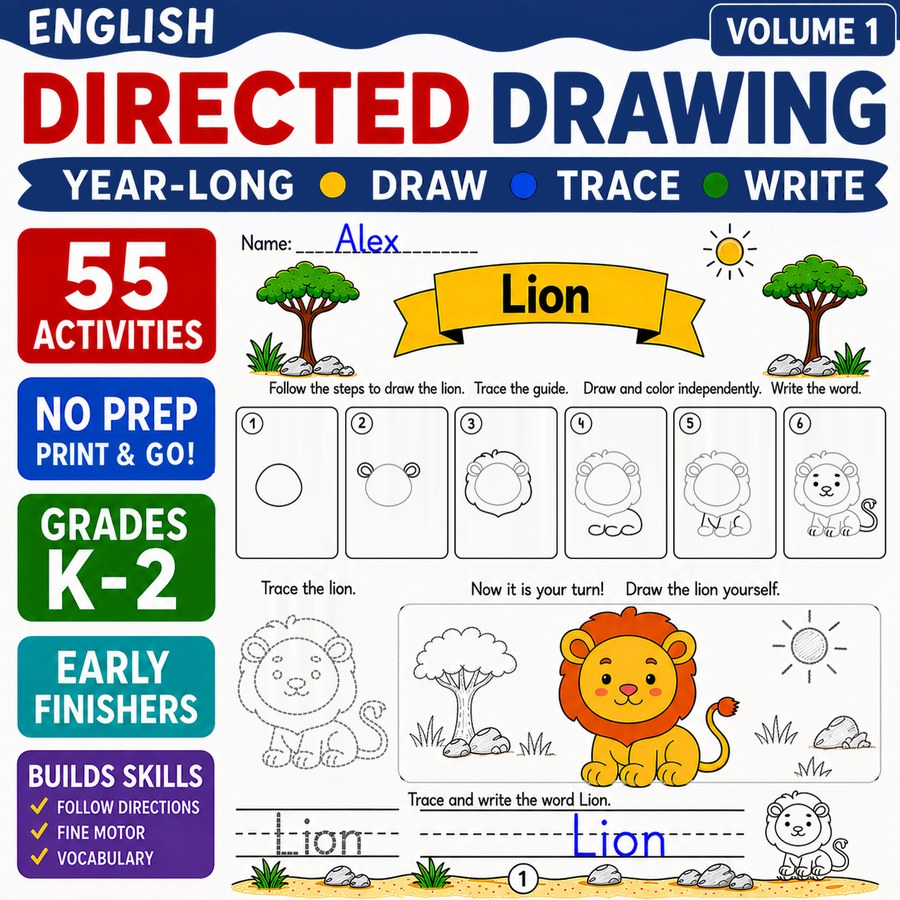
Volume 1
55 drawings · 110 worksheets
$5.99
One directed drawing activity is easy. Making it a routine is the hard part. What changes when a year of practice already sits inside one book.
Directed drawing is an activity in which students build a picture by following a sequence of drawing steps. It becomes a routine rather than a one-time lesson when the steps, the tracing practice and the space to draw independently are all in one place, so the teacher does not have to find, print and collect a new worksheet every week. At three activities a week, 111 drawings cover a 37-week school year.
Adding one directed drawing activity to an elementary classroom is not complicated. Find a picture, show the steps, hand out paper, let students draw. The challenge begins when you want to do it regularly: another activity next week, and another after that, plus copies, paper, a place for finished work, and something students can follow without the teacher beside them every minute.
When we created How to Draw 111 we approached the problem differently: what if each student had an entire year of drawing practice already organized inside one book? That idea shaped the format. The book contains 111 different drawings across 231 pages, and almost every drawing gets a complete two-page spread with everything needed to finish the activity.
Every activity follows the same routine. The student follows the drawing steps and sees how the picture develops from simple shapes. Then they trace the finished picture along a dotted outline. Then they draw it independently in the blank space beside it. Then they color the result.
For students the routine becomes familiar: look, trace, draw independently, color. For teachers that consistency matters too. Once students understand how one activity works, they do not need a new set of directions every time they open the book.
In many directed drawing activities students have to compare two nearly identical pictures to work out what was added. We wanted to remove that extra step: previously drawn lines turn gray while the new lines stay black, so the next action is visible at once.
It is a small detail, but it follows a larger rule we kept while developing all 111 activities: a drawing instruction should make the next action visually obvious. Attention should go into drawing, not into searching for the difference between Step 4 and Step 5.
The math is simple: three drawings a week across 37 school weeks is 111 activities. At two a week the same collection covers the year with a margin, which means a teacher can choose rather than having to use every page.
There is no fixed schedule either. Drawings can be selected by student interest, classroom theme, season, available time, or simply left to the students to choose.
Printables are useful, but regular printing creates its own routine: find, download, print, copy, distribute, collect, organize. An individual book changes that to: get your book, open the activity, draw, close it, put it away.
There is no page to lose and no work to sort between students. Months of a child's artwork stay together in the order it was made, and by the end of the year the book is no longer identical to the one the student received in September.
A drawing activity does not always need a full art period. A self-contained 15 to 20 minute activity fits morning work, early finishers, independent work time, art centers, elementary art lessons and homeschool sessions.
The drawing instructions are visual, so students see the sequence instead of reading paragraphs. That makes the activity less dependent on reading level, which is practical for beginning readers and for classrooms where students have different levels of English proficiency.
Tracing gives students a completed shape to follow. Independent drawing removes that guide: now the student decides where a line begins, how large a shape should be, and where it belongs in relation to the rest of the picture.
That is why the blank space is not decoration. It is the next part of the activity, and it is the reason 111 drawings take 231 pages: we chose practice space over squeezing more small tutorials onto each page.
Directed drawing is an activity in which students create a picture by following a sequence of drawing steps. A clear sequence breaks a finished image into smaller actions so students do not have to figure out the entire drawing at once.
A useful no-prep activity contains the instructions and practice space students need without the teacher creating extra materials. In How to Draw 111 each activity includes visual steps, a dotted picture to trace and space for independent drawing on the same spread.
Yes. A self-contained activity works as morning work once students understand the routine and can follow the visual sequence independently. One drawing fits into about 15 to 20 minutes, with coloring continued later if needed.
It works well because students can begin a defined activity and produce a finished result without waiting for another assignment. Keeping the instructions and drawing space together also removes the need to hand out an additional worksheet.
At three activities per week across a 37-week school year the total is 111. At two per week the same 111 drawings cover the year with a margin, so teachers can select activities rather than completing every one.
Visual directed drawing requires very little reading. When each new line or shape is clearly shown, students follow the sequence by looking at the pictures rather than reading written directions.
Tracing provides an existing line to follow. Independent drawing requires the student to decide where the line begins, how it is shaped and where it belongs. Using both in sequence creates a progression from guided practice to an independent attempt.
A book keeps the instructions, the practice and the finished work together, and it removes the repeated cycle of printing and organizing new worksheets. At the end of the year the student has one book containing months of their own artwork.
Every illustration was drawn by hand by our illustrator, without the use of artificial intelligence. The English edition was a finalist in the Educational category of the Children's Book International Awards 2025.
Words and directions in English.
55 drawings · 110 worksheets
$5.99
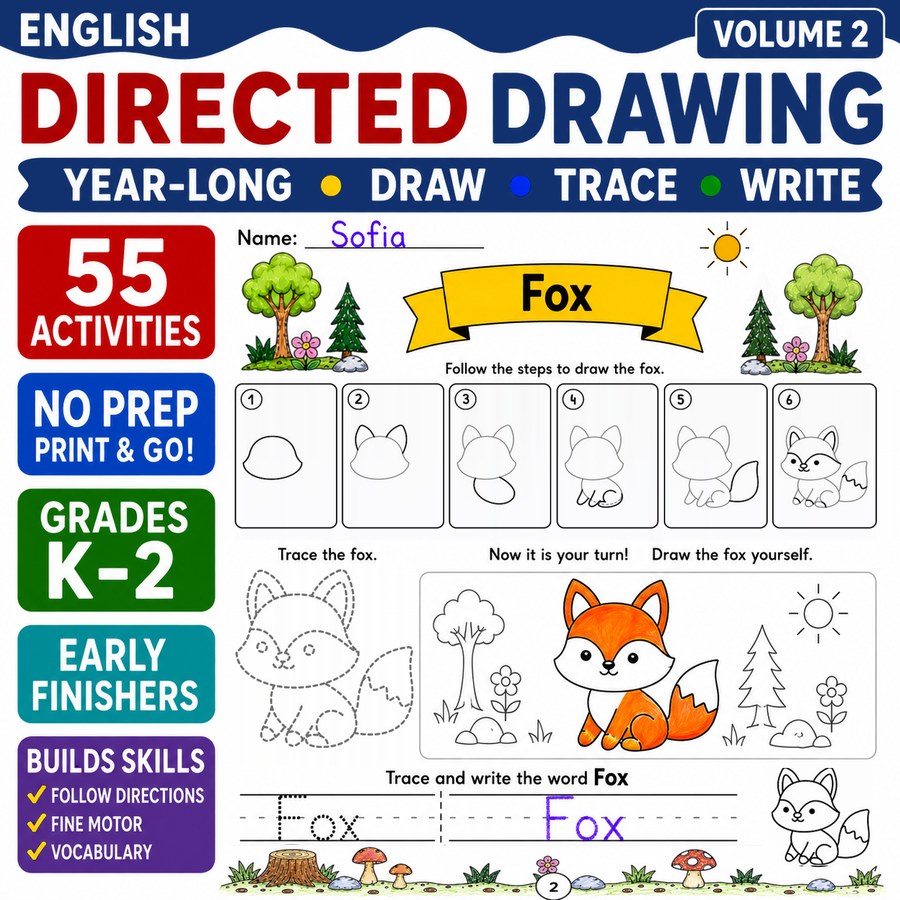
55 + 1 bonus · 112 worksheets
$5.99
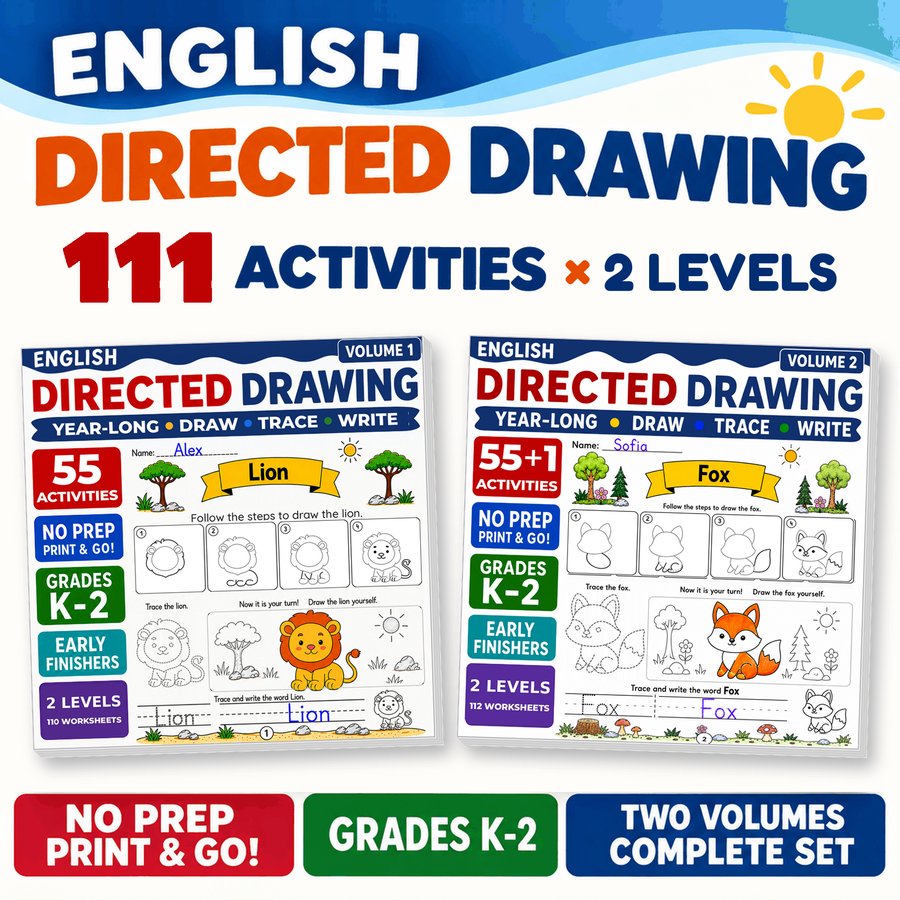
111 drawings · 222 worksheets
$9.98$11.98Save $2
Every word and direction on the student pages is in Spanish. Teacher page in English.
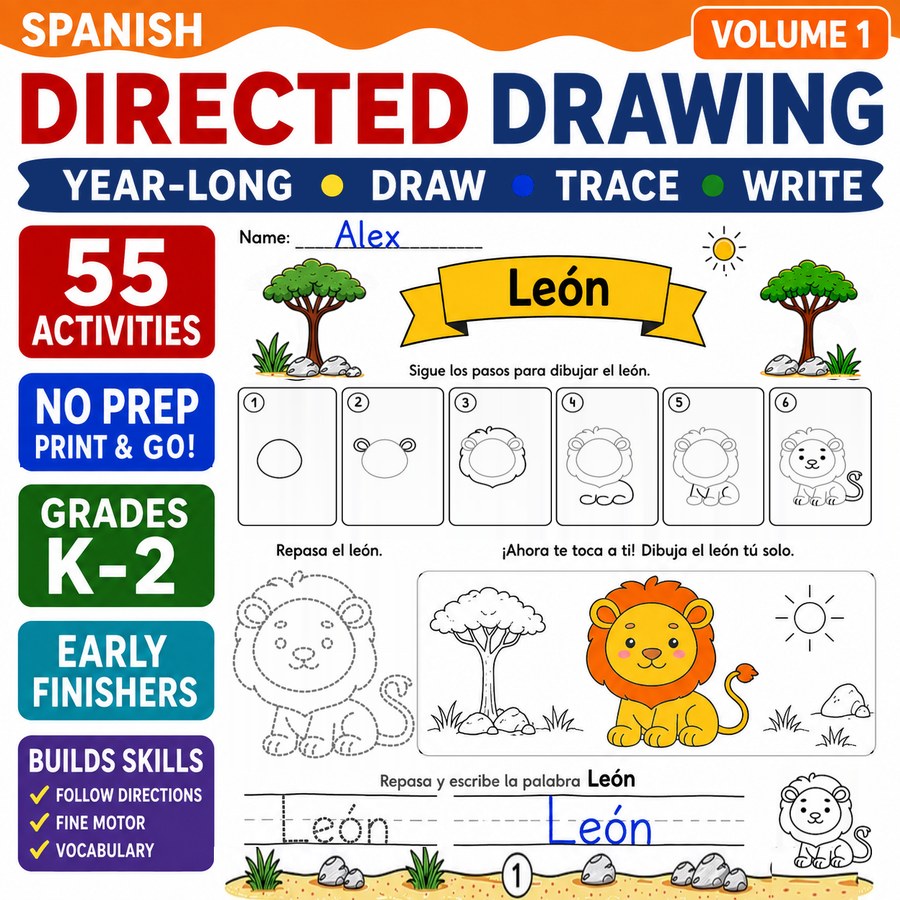
55 drawings · 110 worksheets
$5.99
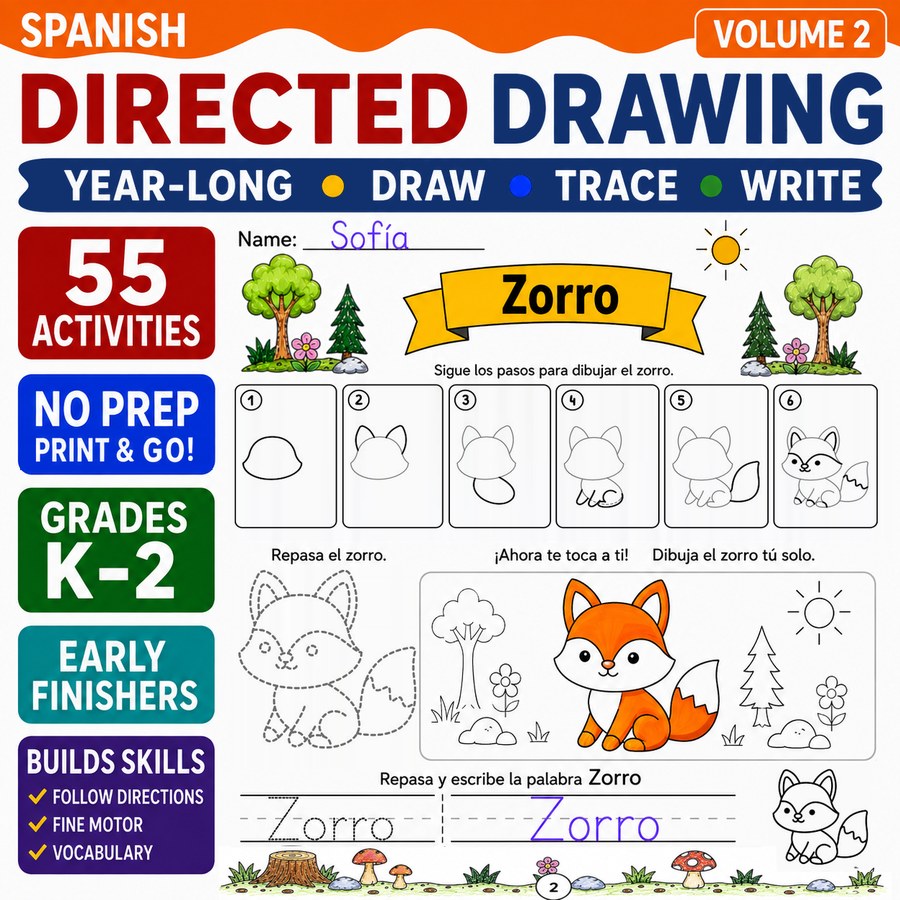
55 + 1 bonus · 112 worksheets
$5.99
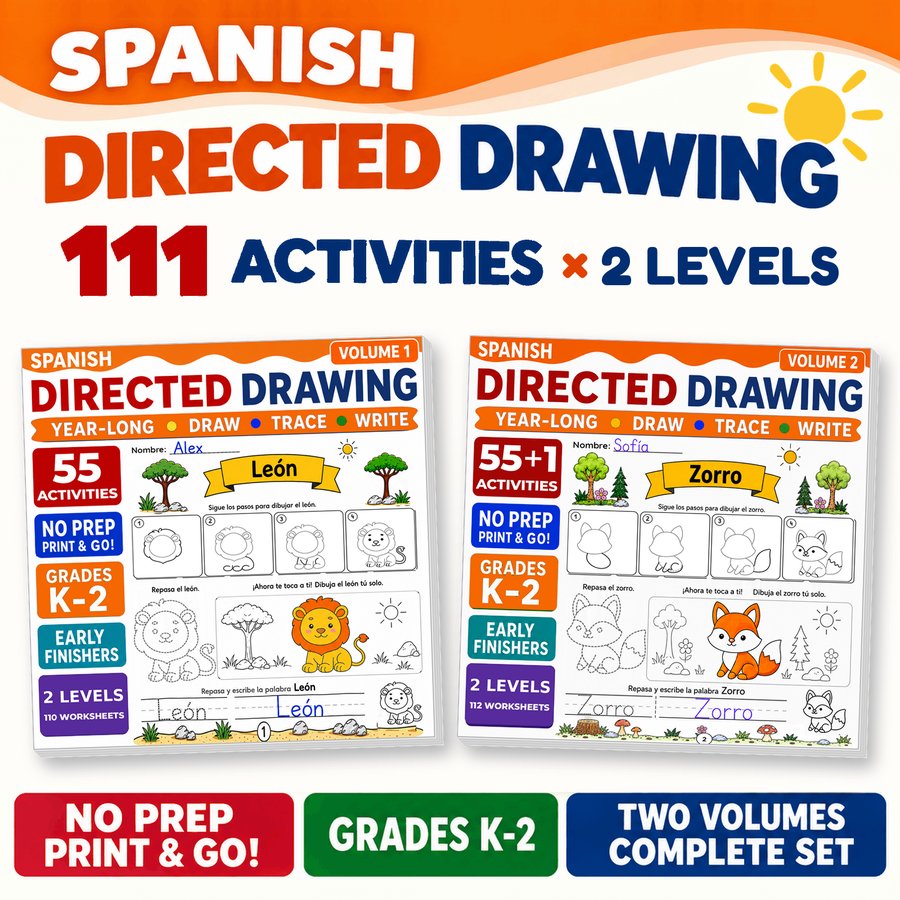
111 drawings · 222 worksheets
$9.98$11.98Save $2