
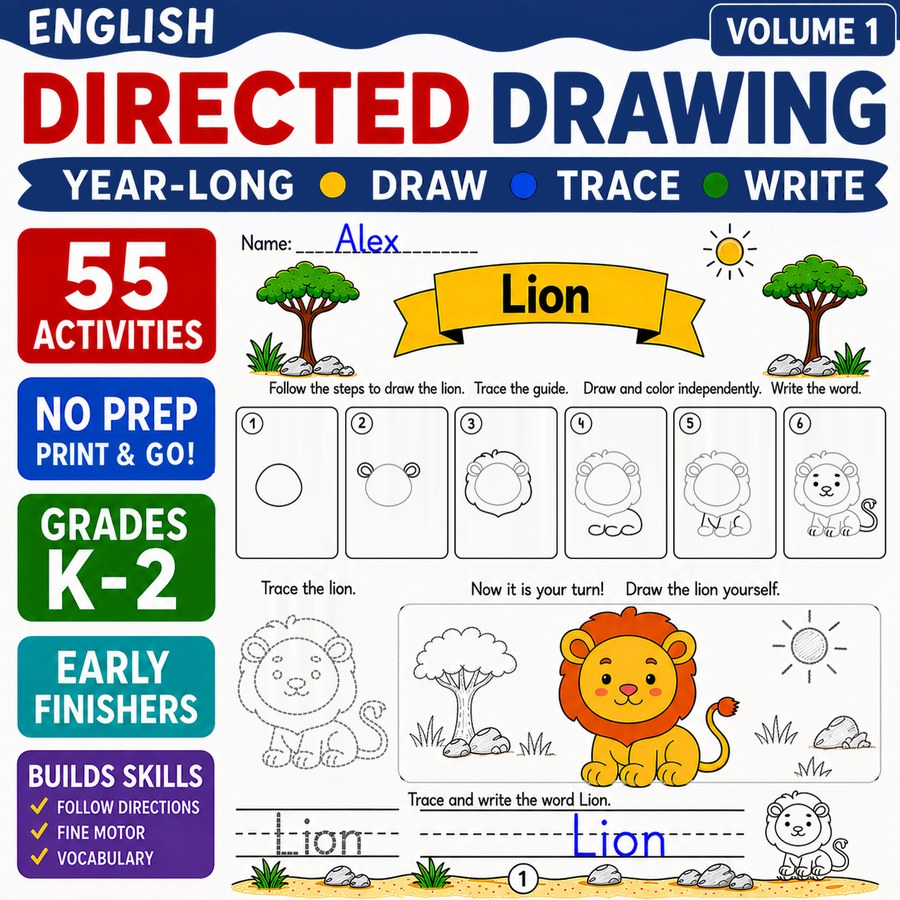
Volume 1
55 drawings · 110 worksheets
$5.99
Why the drawing and the word belong on the same sheet, and what changes when they do.
Directed drawing and writing is a draw and write routine for grades K-2, ages 5 to 8, in which a student builds a picture from simple shapes by following a step by step visual sequence, traces the finished outline, draws the subject independently, and then traces and writes the matching word on primary ruled lines. Drawing and handwriting happen on one page, in that order, so the word a child writes names the picture the child has just drawn.
A blank page asks a young student three questions at once: what to draw, where to start, and how big to make it. Most children answer the first two badly and give up on the third. A visual sequence removes all three questions. The student is not inventing, the student is following, and following is a skill that can be practiced on Monday and used on Friday.
Tracing sits in the middle on purpose. It is the bridge between copying a model and working without one. The hand repeats a movement it has just seen, then repeats it again with nothing to lean on. Handwriting instruction has used the same order for a century: trace the letter, then write it. Here the drawing follows that order first, and the word follows the drawing.
A word written under a drawing is not decoration and it is not a spelling test. It is the moment the picture becomes language. The student has spent four or five minutes looking closely at a lion, so the letters L, i, o, n are attached to something specific rather than to a flashcard.
The lines are primary ruled, the three line format used in most K-2 classrooms, with a dashed midline. The word is traced first and written second, which means a kindergarten student who cannot yet form letters from memory still finishes the page, and a second grader who can writes it twice without being held back.
These pages are used in writing centers more often than at an art table, and that is the point. The page produces one drawing, one traced word, and one written word, which is enough to display, enough to send home, and short enough that it does not eat the block.
Teachers who want more writing extend the page rather than replace it: the student adds a sentence about the drawing on the back, or the class writes the same word on a chart. The printed page does not ask for that, and does not prevent it.
It is a routine that pairs step by step drawing with handwriting practice on a single sheet. The student follows a visual sequence to draw a subject, traces the outline, draws it independently, then traces and writes the word that names it on primary ruled lines. It is used in grades K-2 for fine motor practice, letter formation and vocabulary at the same time.
Both, in that order. The drawing comes first and takes most of the page, the writing closes it. Teachers usually count it as literacy work rather than art, because the page ends in a written word on primary ruled lines.
Yes, because the word is traced before it is written. A student who cannot yet form letters from memory traces the dashed word and still finishes the page. Second graders write it independently and often add a sentence of their own.
No. Every subject is broken into circles, curves and straight lines across four to eight steps, Level 1 even prints a light gray starting shape in the drawing box, and the fourth stage still shows the finished outline to trace. A student who does not consider themselves good at drawing finishes with a drawing that looks like the model.
It depends on the grade and on whether students color. As a warm-up it stays short. With coloring and a background added around the drawing it fills a longer independent block.
One free activity from each theme, or the full year-long collection. Both on Teachers Pay Teachers.
Words and directions in English.
55 drawings · 110 worksheets
$5.99
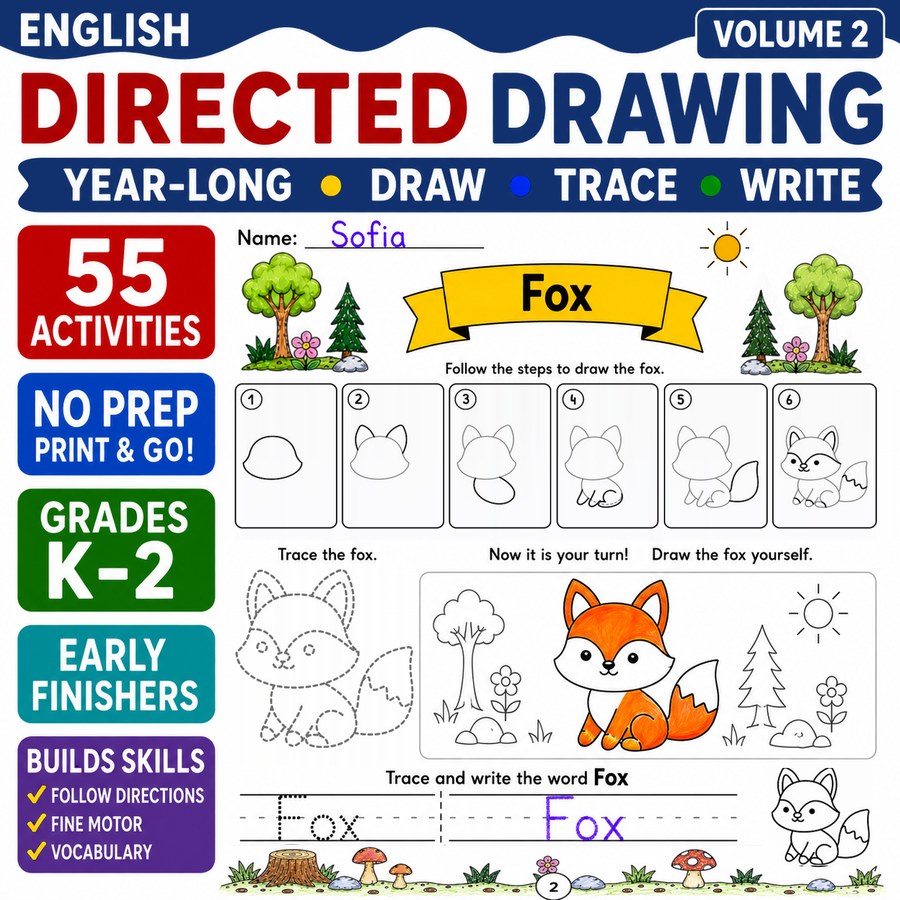
55 + 1 bonus · 112 worksheets
$5.99
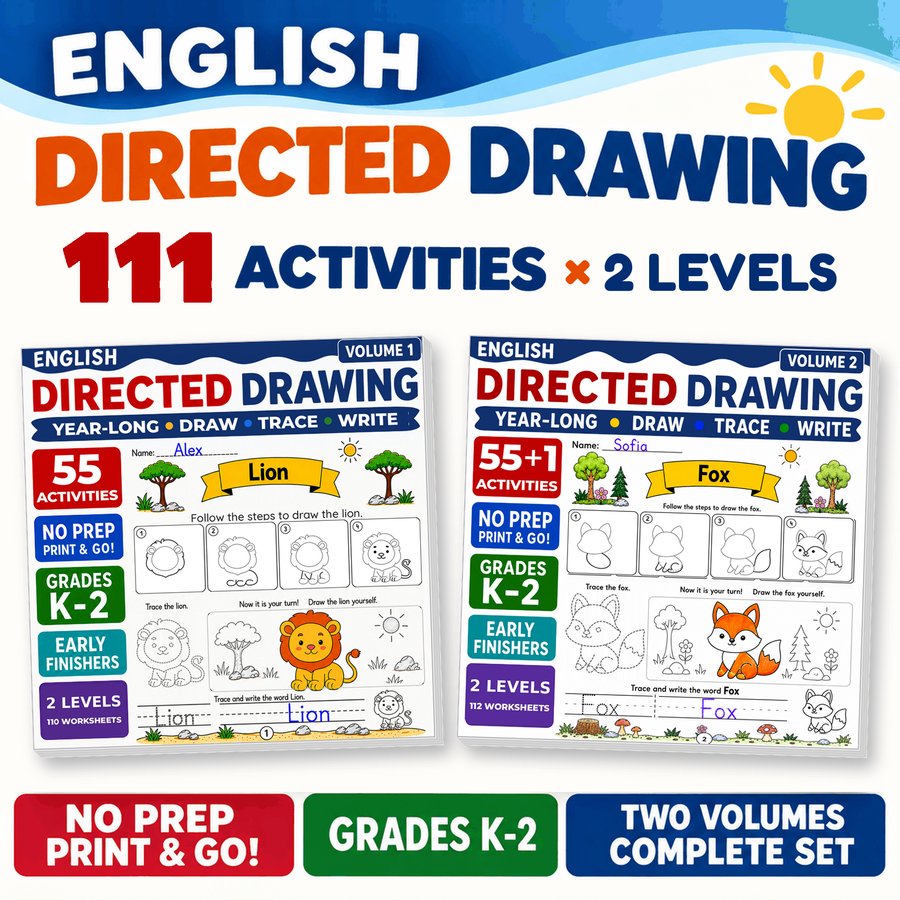
111 drawings · 222 worksheets
$9.98$11.98Save $2
Every word and direction on the student pages is in Spanish. Teacher page in English.
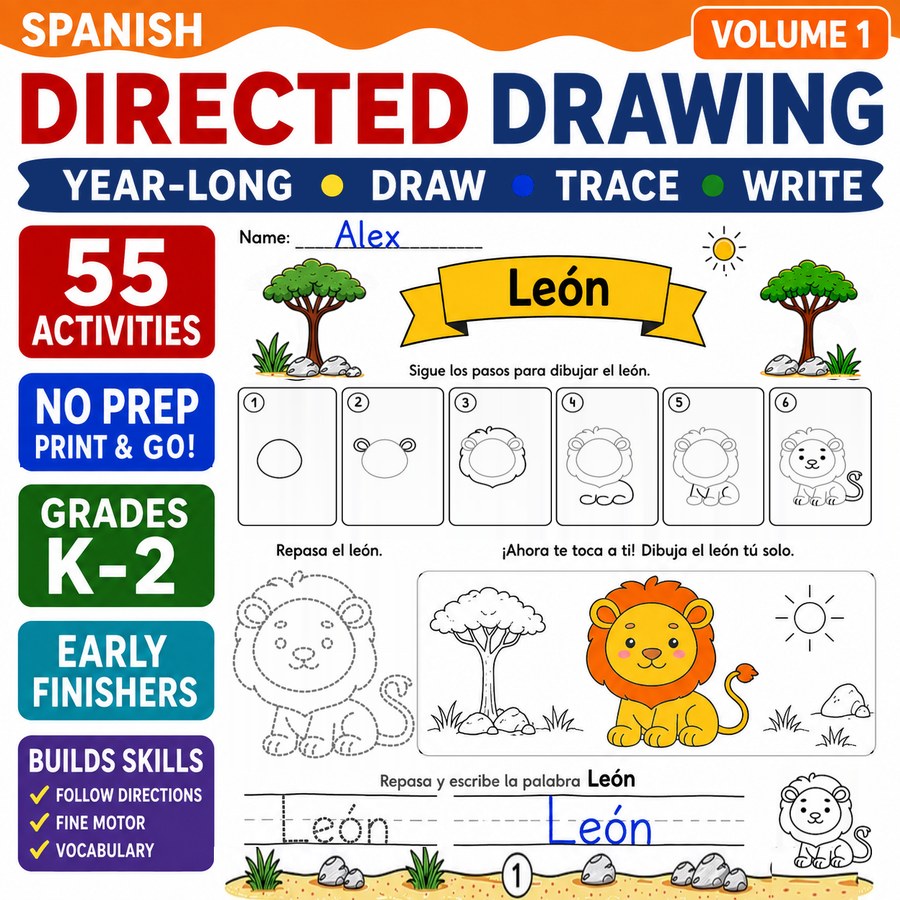
55 drawings · 110 worksheets
$5.99
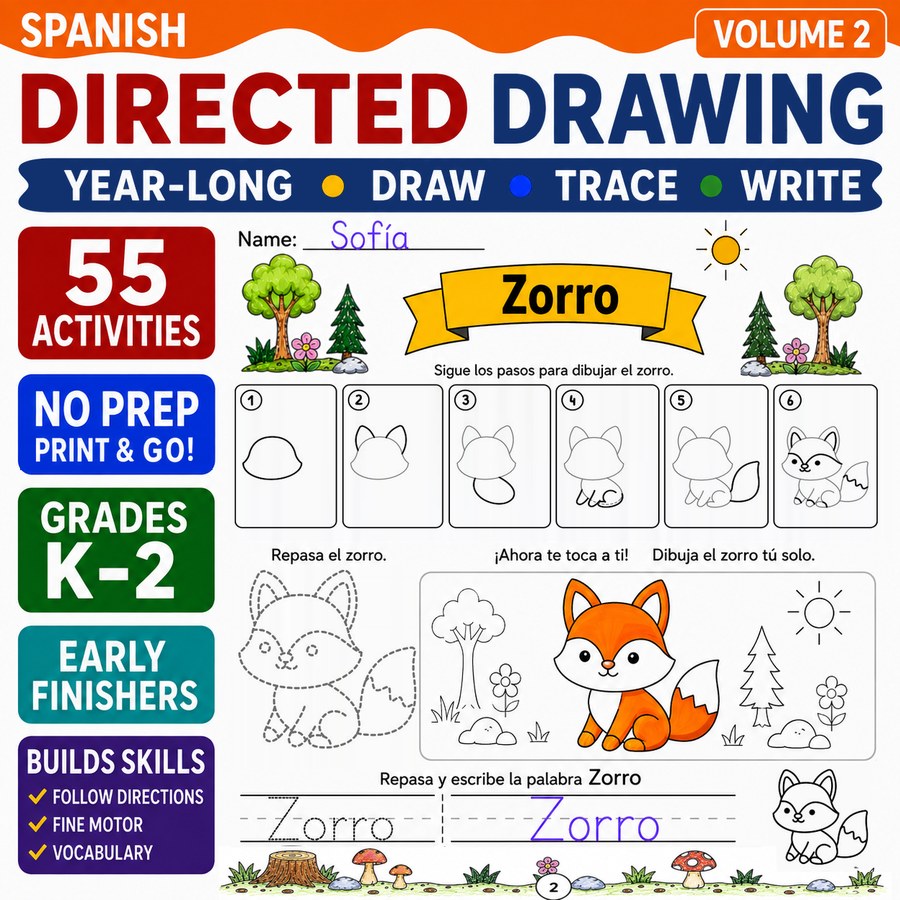
55 + 1 bonus · 112 worksheets
$5.99
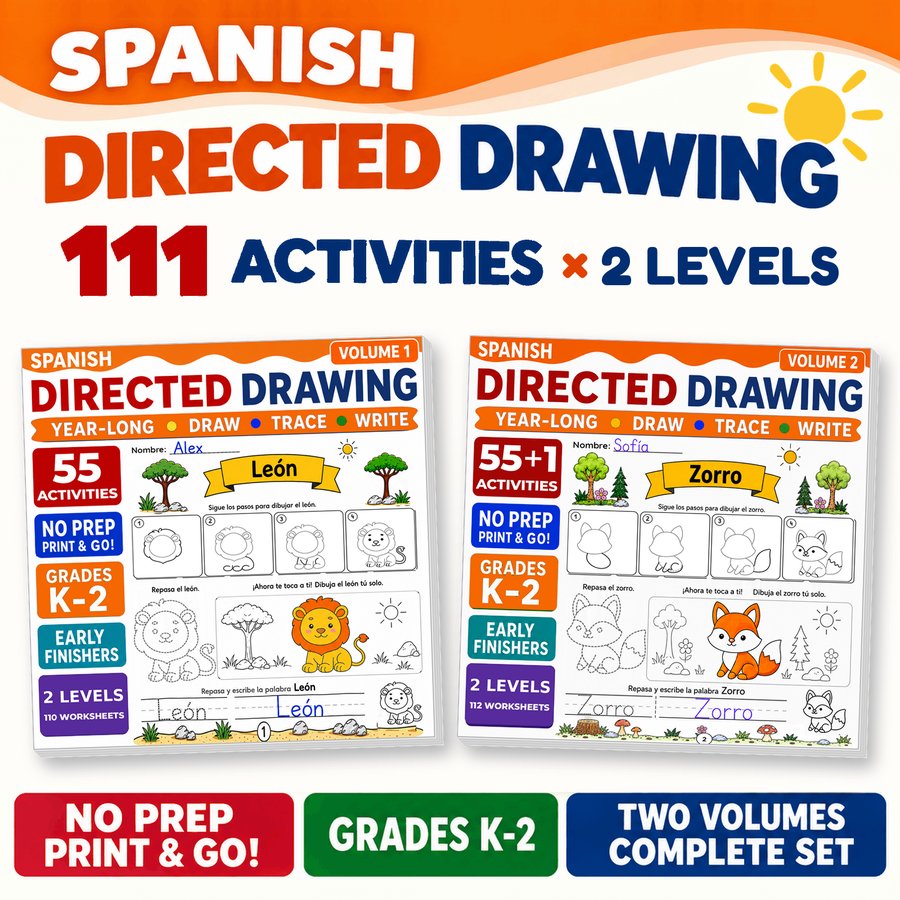
111 drawings · 222 worksheets
$9.98$11.98Save $2