
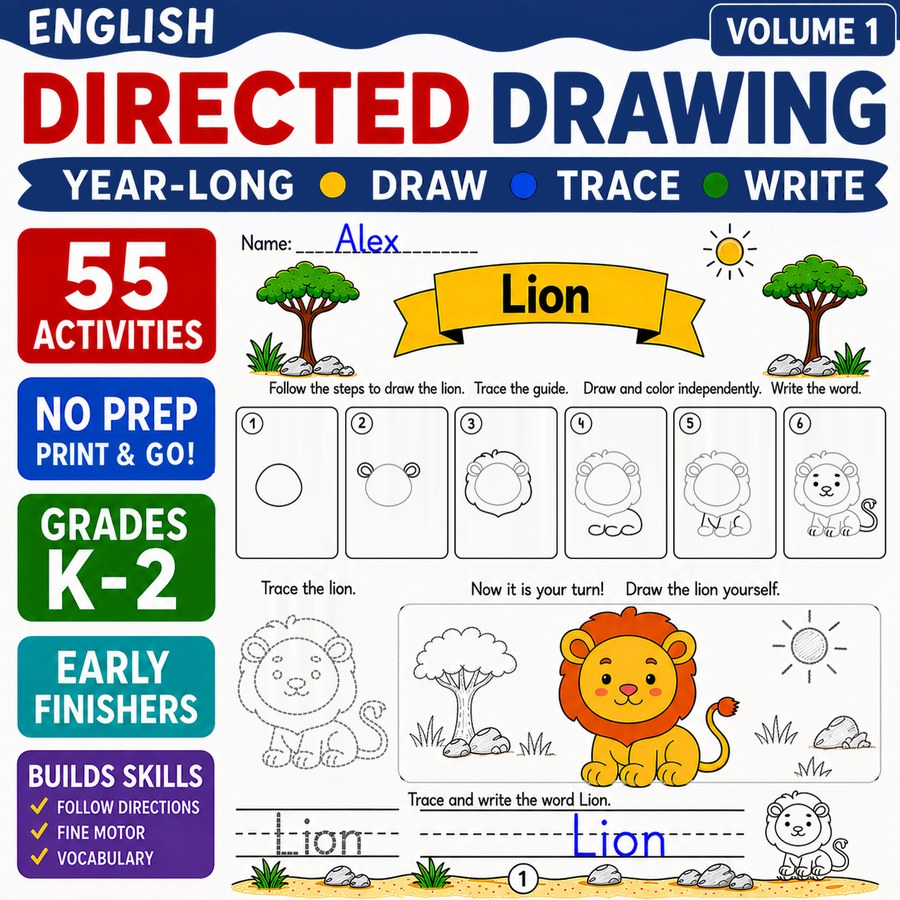
Volume 1
55 drawings · 110 worksheets
$5.99
What a directed drawing page actually practices, and why it holds up with students who need a predictable routine.
Directed drawing practices fine motor control, spatial awareness on the page, following directions, letter formation and vocabulary at the same time, for students in grades K-2. Because the instructions are pictures rather than sentences, the same page works for English learners and newcomers, and because every page follows the same four stages in the same order, it holds up with students who need a predictable routine.
Fine motor work is not one skill, it is several. Holding a pencil at a workable angle, keeping pressure steady, stopping a line where it should stop, and drawing a curve without rotating the whole arm. Breaking a subject into circles, curves and straight lines gives a student short, repeated attempts at each of those instead of one long attempt at everything.
Tracing a dashed outline adds something a free drawing cannot: the hand practices a movement that is already correct. That is the same reason handwriting programs trace letters before writing them.
Deciding where a drawing goes is a real difficulty for five and six year olds, and it is invisible until you see the drawing crammed into a corner. Each page gives a defined box for the independent drawing, which sets the size and the position without an adult saying anything.
That skill transfers directly. A student who can place a lion inside a box is closer to placing letters on a line.
Following directions is on almost every K-2 report card and is hard to practice on purpose. A step by step sequence is a small, self-checking exercise in it: a student who skips step three sees it, because the drawing stops matching the model.
The feedback comes from the page rather than from an adult, which is why the activity survives in a class of twenty.
A newcomer who cannot yet follow spoken instructions can still complete a page, because the instructions are drawings. That matters in the first weeks, when the alternative is sitting through work that cannot be started.
Each page carries exactly one word, attached to a picture the student has just spent minutes on. The same collection is published with Spanish vocabulary on every page, so a dual language teacher can run the same routine in both languages, and a newcomer can meet the word in the language they already have.
Teachers use these pages with students who need a predictable routine and a clear model. Every page repeats the same four stages in the same order, so the format is learned once and never re-explained. A student who is not ready to draw independently can stay on the tracing stage as long as needed, and nothing on the page is timed.
At home the same properties matter for a different reason: a parent teaching two children of different ages can hand the same page to both and let each work at the stage they are ready for, ages 5 to 8.
It breaks a complex figure into circles, curves and straight lines, so a student makes many short controlled strokes instead of one long uncertain one. Tracing a dashed outline then rehearses a movement that is already correct, which is the same principle handwriting instruction uses when it traces letters before writing them.
Teachers use these pages with students who need a predictable routine and a clear model. The four stages repeat in the same order on every page, the subject is broken into simple shapes, and a student who is not ready to draw independently can stay on the tracing stage. Nothing on the page is timed.
Yes. The instructions on the page are pictures, so a student who cannot yet follow spoken directions can still start and finish. Each page carries one word tied to the image just drawn, and the same activities are published with Spanish vocabulary for dual language classrooms.
Yes, and it is self-checking. A step by step sequence shows the student immediately when a step has been skipped, because the drawing stops matching the model. The correction comes from the page rather than from an adult.
Yes. Nothing about the format assumes a classroom. Children ages 5 to 8 work through a page alone once the routine is familiar, and the full book holds 55 drawings at two levels, which is one a week for a full school year with pages left over.
The free sample is eight complete activities with nothing shortened and no watermarks.
Words and directions in English.
55 drawings · 110 worksheets
$5.99
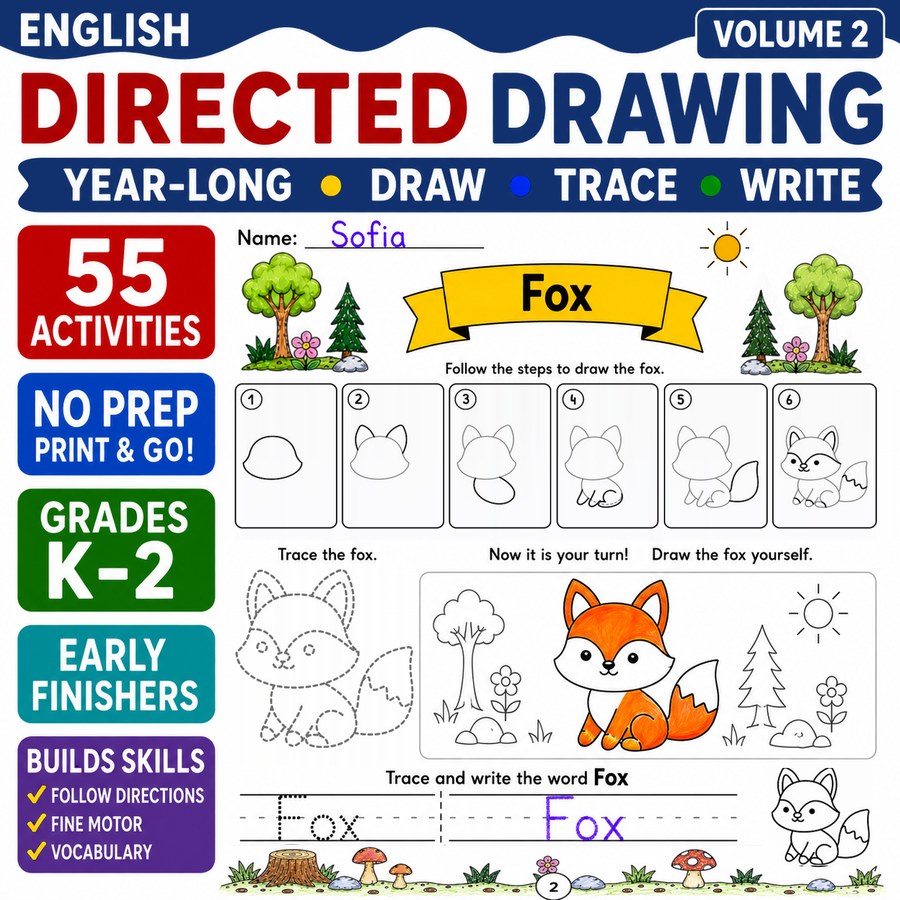
55 + 1 bonus · 112 worksheets
$5.99
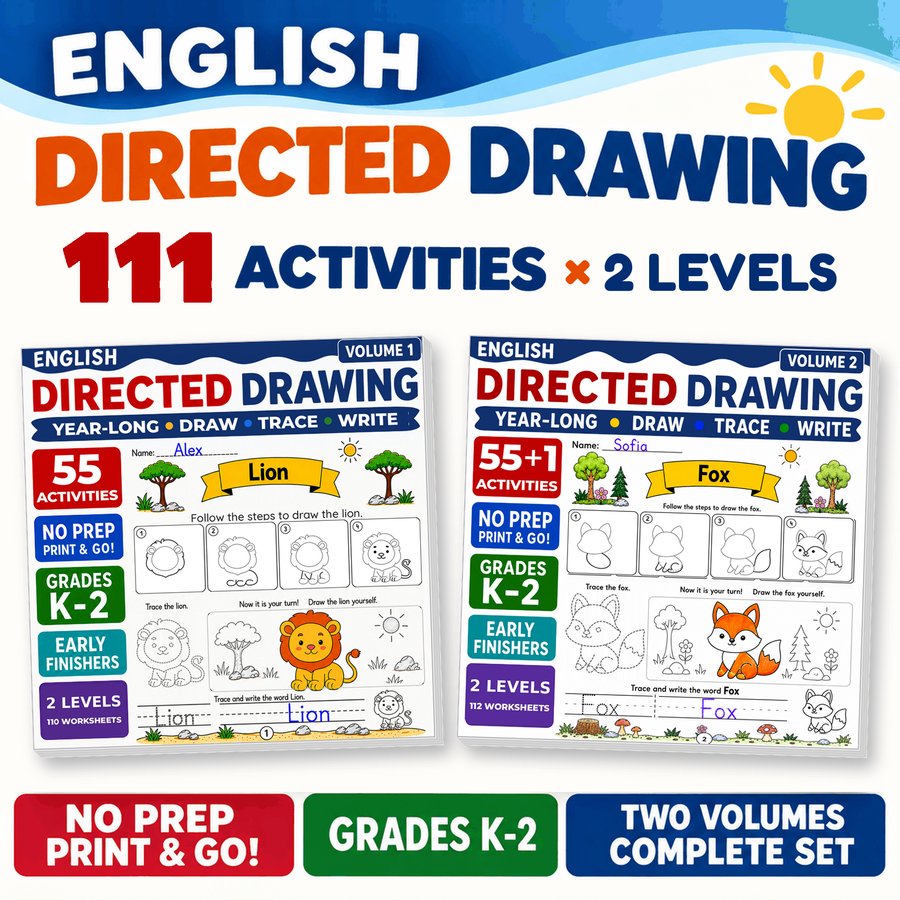
111 drawings · 222 worksheets
$9.98$11.98Save $2
Every word and direction on the student pages is in Spanish. Teacher page in English.
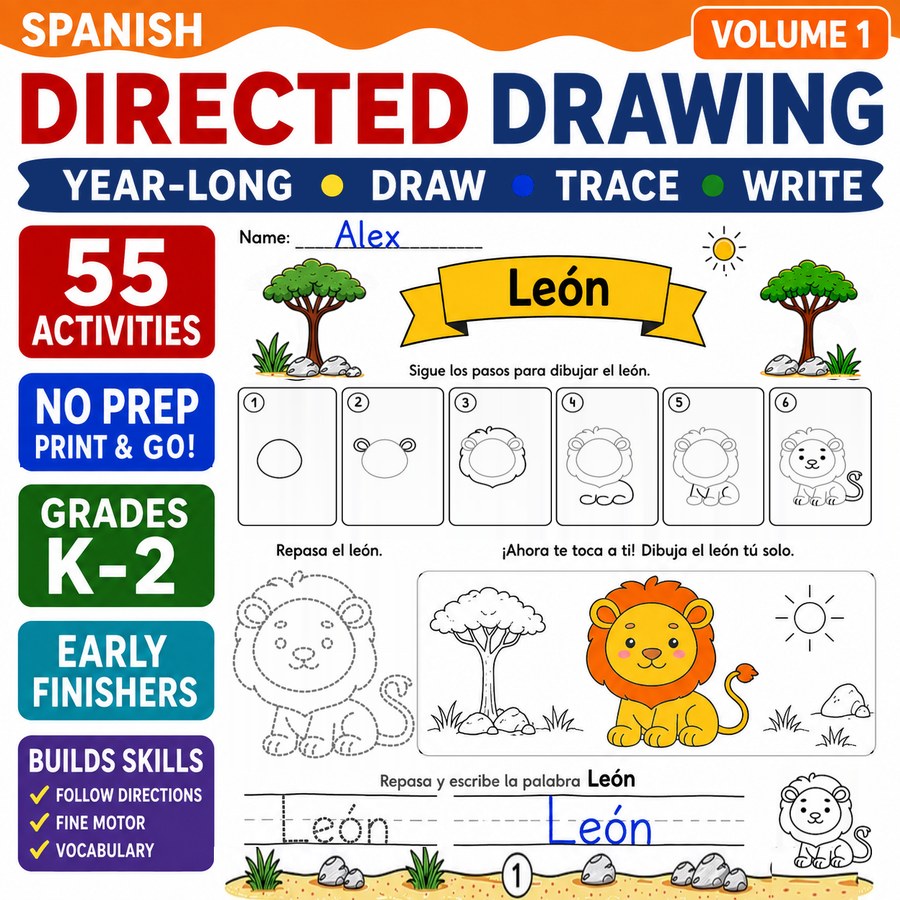
55 drawings · 110 worksheets
$5.99
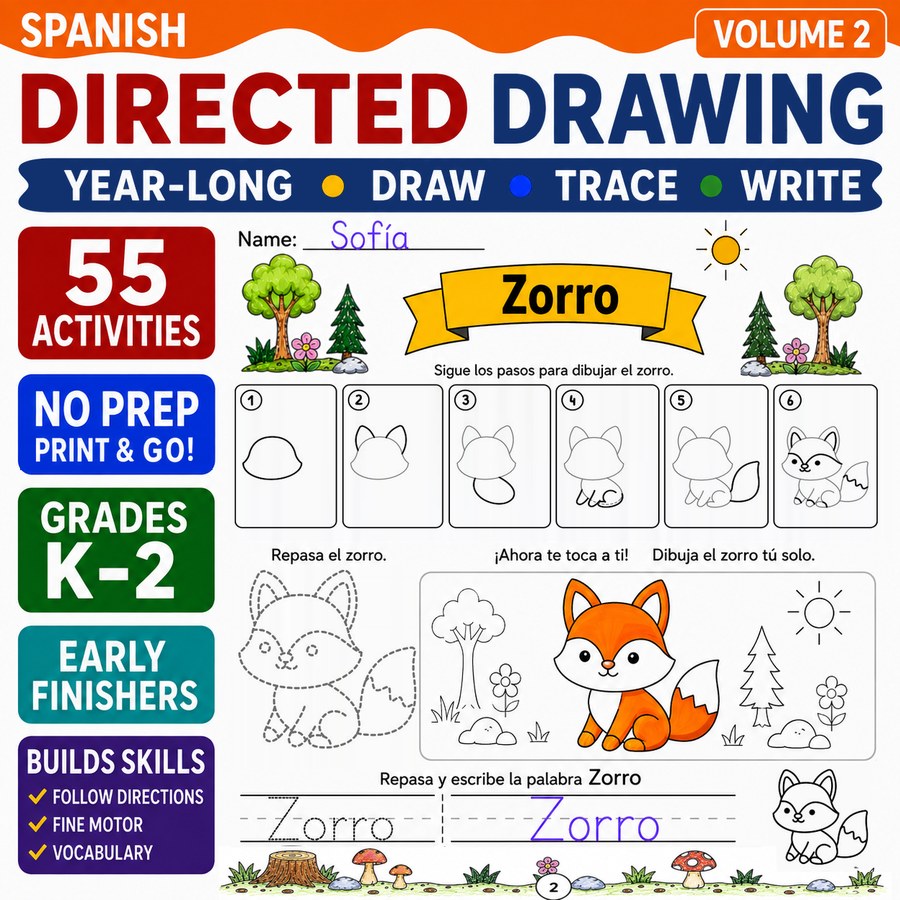
55 + 1 bonus · 112 worksheets
$5.99
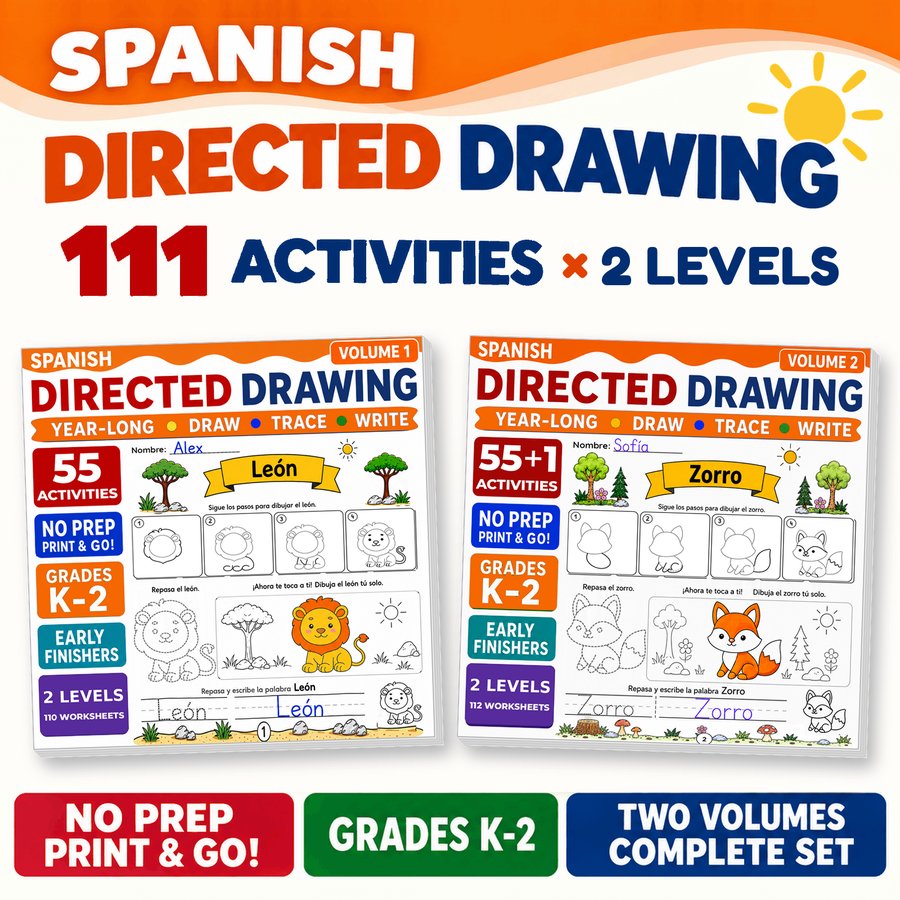
111 drawings · 222 worksheets
$9.98$11.98Save $2